

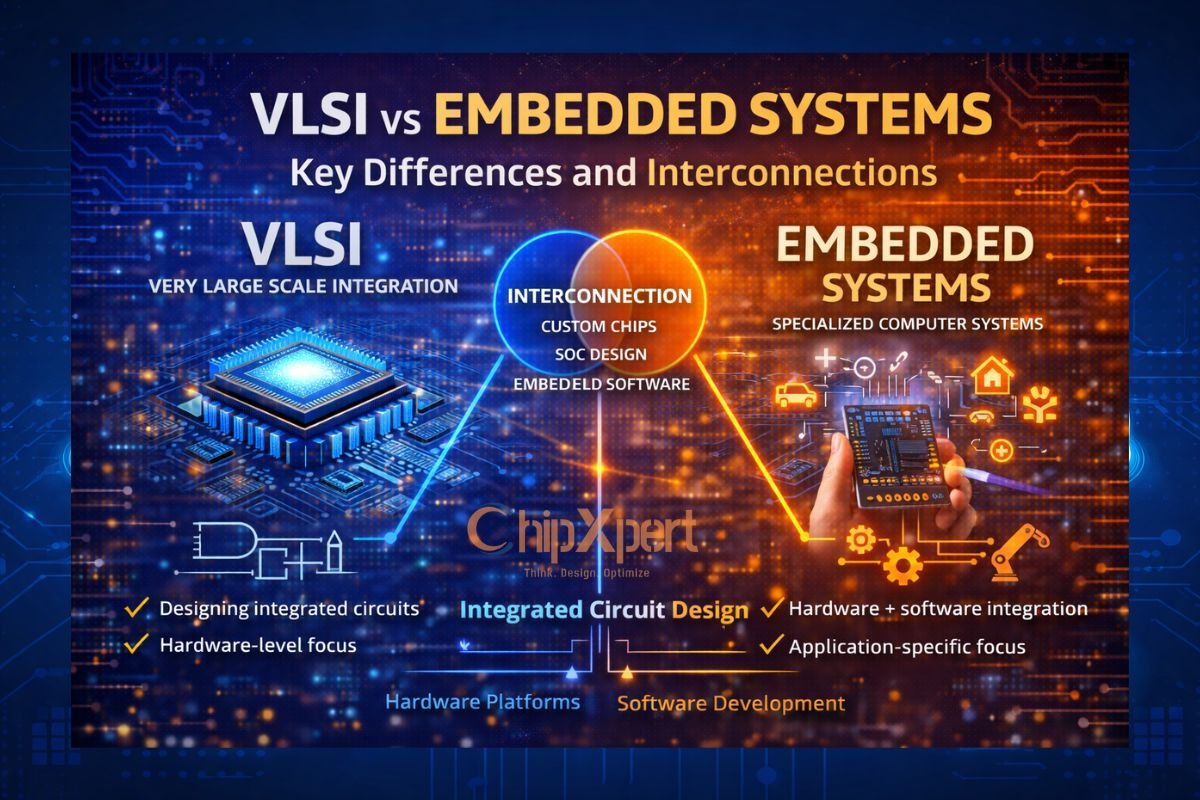
In the rapidly evolving world of electronics and computing, two terms are often discussed by students and professionals alike: VLSI (Very Large Scale Integration) and Embedded Systems. Both fields play vital roles in modern technology, yet they focus on different parts of the electronic design and implementation process.
Understanding how VLSI and embedded systems differ, and how they complement each other, helps engineers and designers make better career decisions and create more efficient hardware and software solutions.
What Is VLSI
VLSI stands for Very Large Scale Integration, which refers to the process of combining millions or billions of transistors onto a single semiconductor chip. This technology enables the creation of complex microprocessors, memory chips, application specific integrated circuits (ASICs), and system-on-chips (SoCs) that power modern devices.
Designing VLSI chips involves deep knowledge of digital and analog circuit design, semiconductor physics, and electronic design automation (EDA) tools. Engineers in this field work at the hardware level to translate functional requirements into circuits that meet performance, power, and area constraints.
What Is an Embedded System
An embedded system is a specialized computer system designed to perform dedicated functions. These systems combine hardware and software to control devices and machines. Unlike general purpose computers, embedded systems often operate with real-time constraints and limited resources.
Embedded systems typically include a microcontroller or microprocessor, memory, and input/output interfaces. They are found in everyday applications such as home appliances, automotive systems, medical equipment, industrial machines, and Internet of Things (IoT) devices.
The primary focus of embedded system design is developing efficient software that interacts with the hardware to control specific tasks, often in real time.
How VLSI and Embedded Systems Differ
Although VLSI and embedded systems are both key parts of electronics, they differ in focus, skill requirements, and typical use cases:
Focus Area
VLSI is mainly concerned with designing integrated circuits that serve as the building blocks of electronic devices. It deals with transistor-level design, physical implementation, and verification of silicon chips.
Embedded systems focus on integrating software with hardware to build systems that carry out specific functions. The hardware may include VLSI chips, but the emphasis is on how components work together to perform tasks.
Skill Set
VLSI designers typically work with hardware description languages like Verilog or VHDL and use tools for synthesis, place and route, and timing analysis. They must understand transistor behavior, logic design, and circuit optimization.
Embedded system engineers often use programming languages such as C, C++, or assembly to develop firmware and software that runs on microcontrollers. They also need knowledge of real-time systems, peripheral interfacing, and communication protocols.
Typical Applications
VLSI design is common in semiconductor companies and research labs focused on building microprocessors, FPGA chips, memory devices, and custom ASICs.
Embedded systems are used in consumer electronics, automotive controllers, IoT devices, robotics, and medical instruments where specific applications are controlled by software interacting with hardware.
Points of Intersection Between VLSI and Embedded Systems
Even though they differ, VLSI and embedded systems frequently interact:
- SoC (System on Chip) design is a prime example of where these fields converge. SoCs created through VLSI design incorporate processors, memory, and peripherals that are used in embedded systems.
- Many modern embedded systems use custom VLSI chips or optimized silicon to achieve better performance and lower power use in specialized applications.
- Embedded software often runs directly on VLSI-defined hardware platforms, making an understanding of both hardware design and firmware beneficial.
This interconnectedness means engineers often benefit from understanding both domains, especially in roles involving hardware-software integration.
Choosing Between VLSI and Embedded Systems
When deciding which field to pursue, consider the following:
- Interest in hardware vs software: If you enjoy circuit design, hardware tools, and semiconductor processes, VLSI design may suit you. If you prefer writing software that controls hardware and solves application-level problems, embedded systems might be a better fit.
- Career opportunities: Both fields offer strong career paths. VLSI design roles are found in semiconductor companies and technology giants, while embedded systems roles span industries such as automotive, IoT, consumer electronics, and industrial automation.
- Skill development: VLSI requires deep hardware expertise and familiarity with EDA tools, whereas embedded systems require strong programming skills and real-time system knowledge.
Understanding your strengths and interests will help guide you toward the right specialization.
Why Both Matter in Modern Electronics
Modern technology blends hardware and software in ways that make both VLSI and embedded systems essential. From smartphones and wearable devices to smart controllers in cars and automation systems in factories, neither domain works alone.
VLSI provides the silicon that makes digital logic and processing possible. Embedded systems bring that silicon to life by executing meaningful tasks in response to real-world inputs.
The collaboration between these fields drives innovation in electronics and enables engineers to build smarter, faster, and more efficient systems.
Conclusion
VLSI and embedded systems represent two distinct yet interrelated domains in electronic design. VLSI focuses on building the physical chips that compute and store data, while embedded systems utilize those chips to perform dedicated tasks within larger systems.
Understanding the differences and overlaps between these fields can help engineers make informed career decisions and design better integrated solutions. As devices become increasingly complex and connected, knowledge of both VLSI and embedded systems will continue to be valuable in shaping the future of technology.
Share your question in comments or talk to our mentor team for batch guidance.
Need Fee, Duration, or Demo Class Details?
Talk to our admin team for the latest batch plan and career guidance.
Contact Admin TeamAsk the Admin Team
Drop your basic question in comments: eligibility, prerequisites, tools, fee range, and placement support.
Our team reviews and responds regularly.