
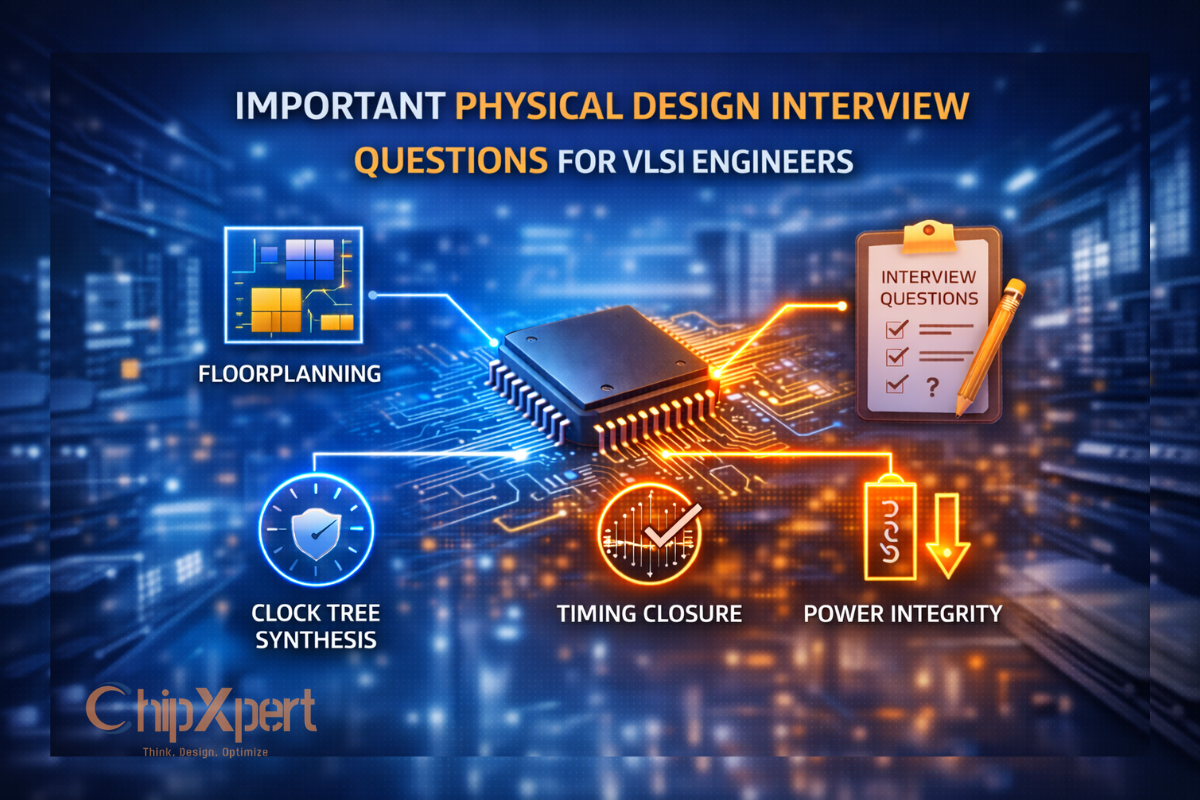
Physical Design is one of the most critical stages in the VLSI chip development flow. It is where abstract logic is transformed into a manufacturable silicon layout that meets performance, power, and reliability targets. Because of its importance, physical design interviews are designed to test not only theoretical knowledge but also real-world problem-solving skills.
This article covers important physical design interview topics and questions that every VLSI engineer should understand, whether you are a fresher or an experienced professional preparing for advanced roles.
What Is Physical Design in VLSI
Physical Design is the process of converting a synthesized netlist into a final layout that can be fabricated on silicon. This includes floorplanning, placement, clock tree synthesis, routing, and signoff checks.
Interviewers often expect candidates to explain physical design in terms of objectives such as timing closure, power optimization, signal integrity, and manufacturability rather than just listing flow steps.
Key Stages of Physical Design Flow
A common interview question focuses on explaining the complete physical design flow clearly.
The major stages include:
- Floorplanning
- Power planning
- Placement
- Clock Tree Synthesis
- Routing
- Physical verification and signoff
Strong candidates explain not only what happens at each stage but also why it is done and what issues can arise if it is handled poorly.
Floorplanning Interview Concepts
Floorplanning is often the first technical topic discussed in interviews.
You may be asked:
- What is floorplanning and why is it important
- How do you decide block placement
- What factors influence core utilization and aspect ratio
An experienced engineer understands that poor floorplanning can lead to routing congestion, timing failures, and power integrity issues later in the flow.
Placement and Congestion Questions
Placement converts logical cells into physical locations within the core.
Interviewers commonly ask:
- What is placement congestion
- How do you reduce congestion
- Difference between global placement and detailed placement
A professional response highlights tradeoffs between timing, routability, and power. It also shows awareness of placement constraints, macro placement challenges, and utilization balancing.
Clock Tree Synthesis Interview Topics
Clock Tree Synthesis is a favorite interview area because it directly impacts performance and reliability.
Typical questions include:
- What is CTS and why is it required
- What are skew and latency
- How do you control clock skew
Experienced engineers explain CTS as a balance between skew minimization, power consumption, and insertion delay rather than a simple buffering step.
Timing Analysis and Timing Closure
Timing is the heart of physical design interviews.
You should be comfortable answering:
- What is setup and hold timing
- Difference between setup and hold violations
- How do you fix setup violations
- How do you fix hold violations
A senior-level answer explains how fixes differ at placement, CTS, and routing stages, and how timing closure is an iterative process rather than a single step.
Routing and Signal Integrity Questions
Routing transforms placement into real metal connections.
Interviewers may ask:
- Difference between global routing and detailed routing
- What causes crosstalk
- How do you reduce signal noise
Good answers include shielding, spacing, buffering, and layer assignment strategies, showing an understanding of real silicon behavior.
Power Planning and IR Drop
Power integrity is a critical area in modern designs.
Common interview questions include:
- What is power planning
- What is IR drop
- How do you reduce IR drop
An experienced candidate explains power rings, straps, grid density, and the impact of switching activity on voltage drop.
Physical Verification and Signoff
At senior levels, interviewers test signoff awareness.
You may be asked:
- What is DRC and LVS
- What is antenna effect
- What is EM and how do you fix it
Strong answers show familiarity with signoff checks and why they matter for manufacturability and long-term reliability.
Real World Debugging Scenarios
Interviewers often evaluate practical thinking using scenario-based questions such as:
- What would you do if timing fails after routing
- How do you handle congestion near macros
- How do you approach ECO changes late in the cycle
Candidates with real experience explain step-by-step reasoning rather than giving textbook definitions.
Skills Interviewers Look For
Beyond technical knowledge, physical design interviewers value:
- Clear understanding of PD flow dependencies
- Ability to analyze tradeoffs
- Awareness of silicon impact
- Structured problem-solving approach
These skills separate strong candidates from those who only memorize concepts.
How to Prepare Effectively for Physical Design Interviews
To prepare well:
- Understand fundamentals deeply rather than memorizing answers
- Practice explaining concepts in simple language
- Review real design issues and fixes
- Be honest about experience level
Confidence comes from clarity, not complexity.
Conclusion
Physical design interviews are designed to test how well you understand the journey from netlist to silicon. Mastery of timing, power, routing, and verification concepts is essential, but equally important is the ability to think practically and explain decisions clearly.
Whether you are starting your VLSI career or aiming for advanced roles, strong physical design fundamentals and real-world awareness will set you apart in interviews and in your professional journey.
Share your question in comments or talk to our mentor team for batch guidance.
Need Fee, Duration, or Demo Class Details?
Talk to our admin team for the latest batch plan and career guidance.
Contact Admin TeamAsk the Admin Team
Drop your basic question in comments: eligibility, prerequisites, tools, fee range, and placement support.
Our team reviews and responds regularly.