

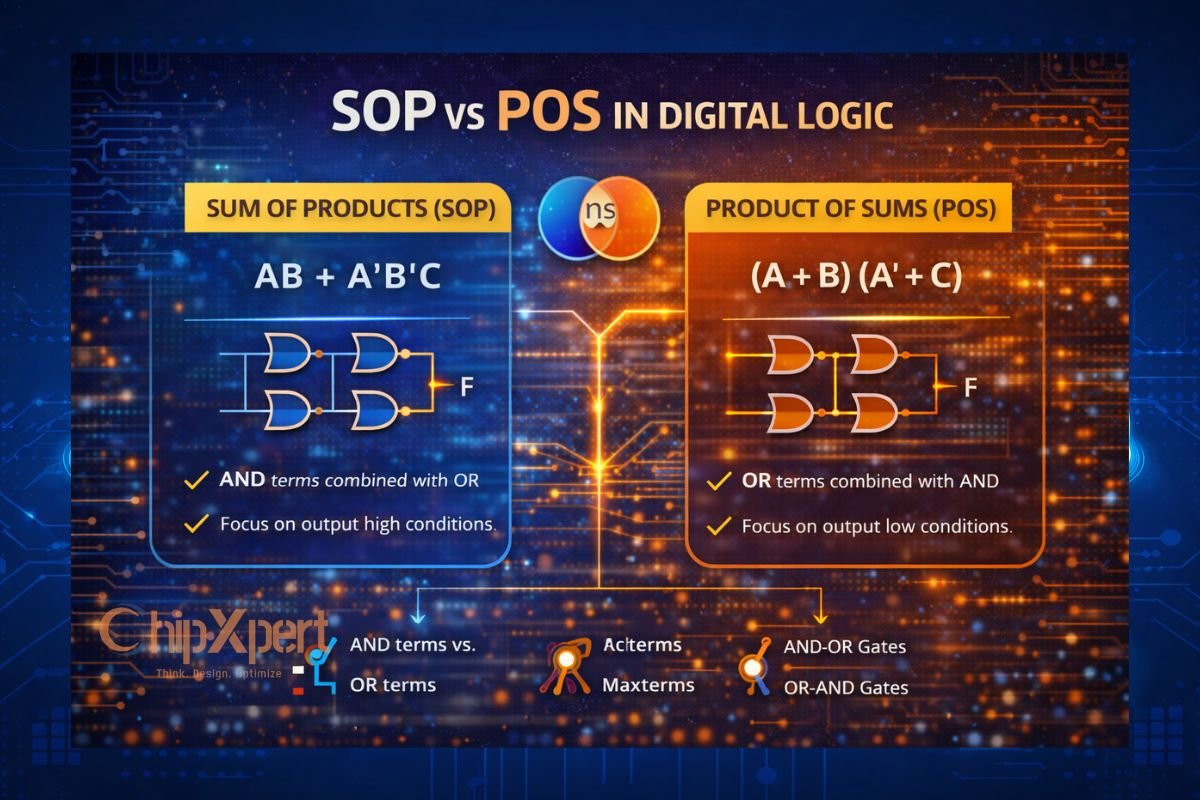
In digital logic and VLSI design, representing Boolean functions in a structured way is essential for simplifying circuits and designing efficient hardware. Two widely used forms of Boolean expression are SOP and POS. Understanding how these forms work and how they differ is important for designing, optimizing, and implementing logic circuits.
In this article, we explain what SOP and POS mean, how they are formed, how they differ, and why both are important in logic design.
What Is SOP
SOP stands for Sum of Products. In this form, the Boolean expression consists of several product terms that are ORed together. Product terms are created by combining variables using the AND operation. Once these product terms are formed, the OR operation adds them together to get the final result.
In the SOP representation, each term is called a minterm. A minterm is a product of all the variables in either true or complemented form, and it gives a logic HIGH (1) output only for one specific combination of input values. SOP is a canonical form that helps systematically express and evaluate logic functions.
For example, a Boolean function can be written as the sum of its minterms, each representing cases where the output is true. This representation makes it easier to analyze and implement digital circuits using AND and OR logic.
What Is POS
POS stands for Product of Sums. In this form, the Boolean expression is made by ANDing together several sum terms. Each sum term is formed by using the OR operation on variables in true or complemented form.
In the POS representation, each term is called a maxterm. A maxterm is a sum of variables and gives a logic LOW (0) output only for one combination of input values. POS is another canonical form that represents how a logic function yields a zero output.
To form a POS expression, you identify the input combinations that produce a logic low and then write sum terms corresponding to them. The final expression is the product of these sum terms.
How SOP and POS Are Formed
Both SOP and POS can be derived from a truth table, which shows all possible input combinations and the resulting outputs for a logic function.
For SOP, you look at rows where the output is high. For each such row, you write a product term that represents the inputs for that case. Finally, you OR all product terms together to form the SOP expression.
For POS, you look at rows where the output is low. For each such row, you write a sum term that captures the input combination that produces zero output. Then you AND all these sum terms together to form the POS expression.
Using tools like Karnaugh maps can make the process of deriving minimal SOP or POS expressions more efficient by grouping similar combinations and reducing the number of logic terms needed.
Key Differences Between SOP and POS
Understanding the difference between SOP and POS is useful when moving from logic expressions to circuit implementation:
- SOP uses product terms while POS uses sum terms. In SOP, AND operations are done first followed by OR, while in POS OR operations come first followed by AND.
- SOP focuses on output high conditions, while POS captures output low conditions when building the expression.
- SOP’s minterms represent all cases where the function is true, whereas POS’s maxterms represent all cases where the function is false.
- SOP is often associated with active high logic design and POS is associated with active low logic design.
- When implemented in hardware, SOP typically maps to AND gates feeding into OR gates, while POS maps to OR gates feeding into AND gates.
When to Use SOP vs POS
Both forms are useful in different design scenarios:
SOP Use Cases
SOP is frequently used in situations where the output must be mapped directly to input combinations that produce a true result. It is commonly used in combinational logic design, truth table simplification, and logic synthesis. SOP also works well when implementing logic with AND and OR gates in a simple, efficient way.
POS Use Cases
POS is often used when the logic needs to be defined by conditions where the output is false. It is especially useful in minimizing logic expressions in certain cases and when implementing logic that is easier to express as products of OR expressions. POS can also offer benefits in negative logic and in designs where low outputs are significant.
Conversion Between SOP and POS
It is often possible to convert between SOP and POS using Boolean algebraic rules. For example, applying De Morgan’s laws helps transform an expression from one form to the other. Simplification techniques like Karnaugh maps are also helpful for minimizing expressions before converting them.
Conclusion
SOP and POS are two foundational forms of expressing Boolean logic in digital systems. SOP expresses logic as a sum of product terms, while POS expresses logic as a product of sum terms. Each form has its own advantages and is used widely in logic design, simplification, and circuit implementation.
Understanding both SOP and POS gives you the flexibility to optimize logic functions for performance, gate count, and reliability in digital circuits. Whether you are designing combinational logic or preparing for advanced digital systems work, mastering these forms is an essential part of VLSI and digital electronics design.
Share your question in comments or talk to our mentor team for batch guidance.
Ask the Admin Team
Drop your basic question in comments: eligibility, prerequisites, tools, fee range, and placement support.
Our team reviews and responds regularly.