

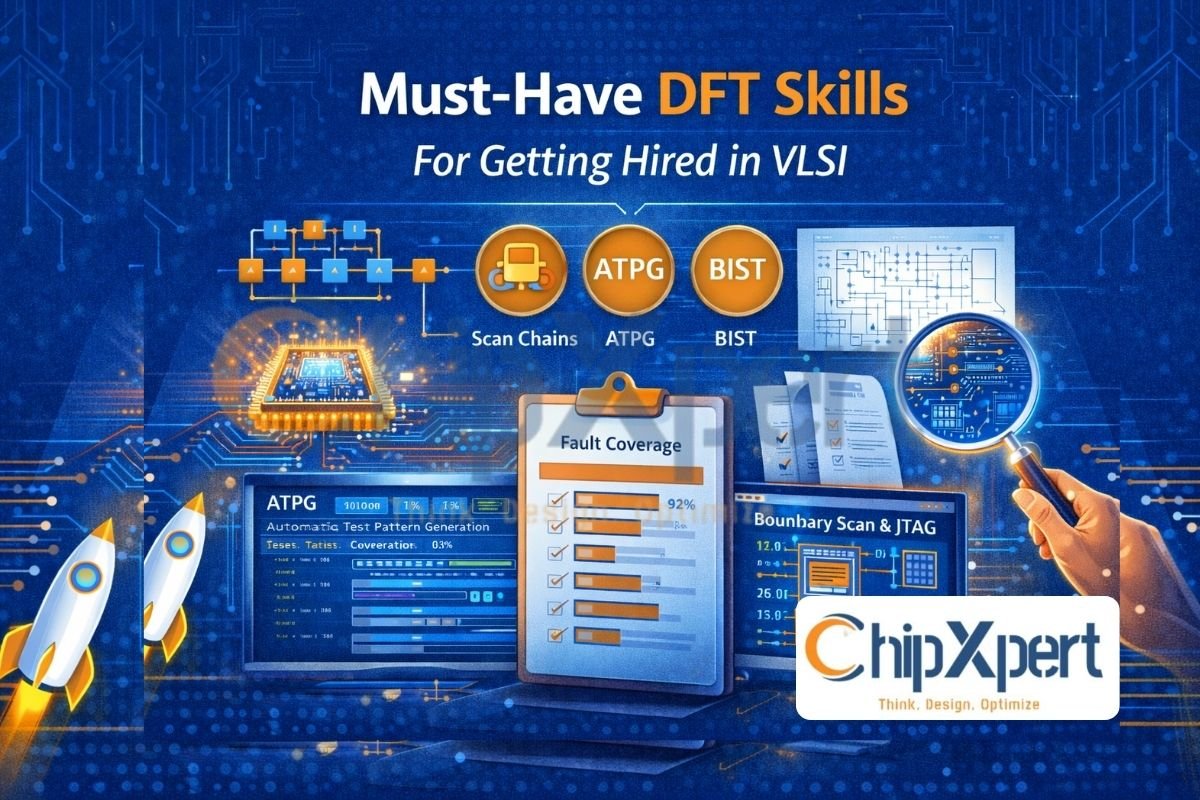
In the rapidly evolving semiconductor industry, Design for Testability (DFT) has become one of the most sought-after skill sets for aspiring chip professionals. As integrated circuits become more complex and densely packed with logic, ensuring they are testable and reliable is crucial to manufacturing success. This makes DFT engineers extremely valuable, because they enable efficient testing, higher quality silicon, and reduced development costs — a combination that every semiconductor company prioritizes.
If you’re targeting a career in VLSI and want more than just theoretical knowledge, mastering DFT skills is a game changer. Let’s explore the essential skills you need, how companies evaluate them, and how to prepare yourself to get hired.
What Is DFT and Why It Matters
At its core, DFT is about designing semiconductor circuits in a way that makes them easy to test after fabrication. Chips are manufactured with billions of transistors, and even a tiny fault can cause a design to fail. Without built-in testability mechanisms, identifying manufacturing defects would be extremely difficult and costly.
A DFT-aware design includes special structures that allow internal nodes to be observed and controlled during testing. These features help engineers detect faults like stuck-at failures, bridging issues, and delay defects efficiently, ensuring that the final product meets quality and reliability standards.
Being skilled in DFT means you understand not only how to make a design work but also how to make it testable and reliable — a skill directly tied to yield optimization and product success.
Core DFT Skill Areas to Master
1. Scan Insertion and Scan Architecture
One of the fundamental tasks in DFT is implementing scan chains. Scan chains convert flip-flops into a shift register structure that enables test patterns to be shifted in and out of the design, allowing internal nodes to be controlled and observed.
To perform well in interviews and on the job, you should be able to:
- Understand how to integrate scan chains without breaking design timing
- Balance coverage goals with design complexity
- Know how to handle lock-up latches and design rule checks
Mastering scan architecture gives you a strong foundation in test coverage enhancement and forms the basis of most advanced DFT techniques.
2. Automatic Test Pattern Generation (ATPG)
ATPG is the process of generating test patterns that expose manufacturing faults inside a chip. Different fault models (e.g., stuck-at, transition faults) require efficient pattern generation to maximize fault detection without excessive test time.
For job readiness, you should know:
- How ATPG tools generate test patterns
- How to interpret ATPG coverage reports
- How test pattern quality impacts overall yield
ATPG competency is one of the key differentiators hiring managers look for in DFT engineers.
3. Compression Techniques and At-Speed Testing
In modern large SoCs, test time and data volume can become unmanageable if traditional testing is used without optimization. Test compression techniques reduce the amount of test data and speed up test application.
Understanding how compression works — along with at-speed testing (testing at functional clock rates) — equips you to handle real-world chips where performance and test efficiency must co-exist.
4. Hierarchical Scan, Boundary Scan & JTAG
As designs grow in size and complexity, companies use hierarchical scan techniques to segment the test process into manageable blocks. Boundary scan (often based on JTAG standards) enables testing of interconnects and helps debug board-level issues.
Knowledge of hierarchical scan strategies and boundary scan protocols signals to employers that you can handle complex test challenges across the entire design hierarchy.
5. Built-In Self-Test (BIST) Integration
BIST refers to embedding autonomous testing circuitry directly into the chip. Memory BIST (MBIST) and Logic BIST (LBIST) are widely used in production environments. A good DFT engineer knows how to integrate and configure BIST modules so that parts of the design can test themselves without external signals.
6. Fault Simulation and Debugging
Generating test patterns is only half the job. Validating them through fault simulation and then debugging coverage gaps is equally important. During interviews, you may be asked how you identify coverage issues and what strategies you use to fix them. Strong debugging skills help you explain not just the result but the reasoning behind the fix.
7. Tool Proficiency
Real-world DFT work is tool-driven. Proficiency with industry tools used for scan insertion, ATPG, compression, and analysis (e.g., popular DFT suites) is a must. Hands-on experience demonstrates to employers that you can transition smoothly into workflow-based environments, rather than learning everything from scratch.
8. Scripting and Automation
Automation sets experienced engineers apart. Scripting languages like Tcl and Python are used to automate repetitive tasks, customize test flows, and generate custom reports. Adding scripting skills to your toolkit shows that you can boost productivity and take on larger responsibilities with ease.
9. Communication and Problem-Solving Skills
While technical skills are the core of DFT jobs, the ability to communicate your approach clearly and solve problems logically is what interviewers notice. Clear articulation of how you diagnose test issues, collaborate with design or verification teams, and explain your rationale often separates average candidates from outstanding ones.
How to Prepare for a DFT Role
Preparing for a DFT position goes beyond knowledge acquisition. Follow a structured approach:
- Build strong fundamentals in digital design and HDL. LinkedIn
- Take specialized DFT coursework that includes projects and lab practice. Semionics
- Practice with ATPG and scan tools to reinforce real-world understanding.
- Work on debugging exercises to sharpen problem-solving skills.
- Develop small automation scripts to handle test tasks efficiently.
- Participate in mock interviews and technical discussions to build confidence.
A combination of theory, practical exposure, and interview practice will make you job-ready and confident when pursuing DFT opportunities.
Final Thoughts
Design for Testability is a specialized and high-demand area within VLSI that stands at the intersection of design and quality assurance. Engineers equipped with scan insertion skills, ATPG mastery, BIST integration understanding, and strong debugging capabilities are increasingly valuable in semiconductor companies. Adding scripting and communication skills further enhances your employability.
With the right preparation, DFT skills can not only get you hired but also accelerate your growth in semiconductor careers, especially as chips become more complex and reliable testing becomes even more crucial.
Share your question in comments or talk to our mentor team for batch guidance.
Need Fee, Duration, or Demo Class Details?
Talk to our admin team for the latest batch plan and career guidance.
Contact Admin TeamAsk the Admin Team
Drop your basic question in comments: eligibility, prerequisites, tools, fee range, and placement support.
Our team reviews and responds regularly.